
Team: Cheryl Wellum | Karima Yulia | Sophia Nwankwo
Problem: How to make people aware of the diminishing butterfly population and its causes?
Solution: A museum experience that allows participants to experience the life cycle of a butterfly and what is threatening its population today

The fragile and beautifully patterned butterfly undergoes many experiences and dangers from the moment it is produced as an egg on a leaf.
Rather than show people how man’s lifestyle has negatively impacted the butterfly population and habitat, our goal is to have people experience a butterfly’s life and to have empathy for its struggles.
The Museum Experience through the Eyes of a Child
In order to understand how children experience a museum and what is important to them, we interviewed some children who have had a previous museum experience. In order to generate memories and stimulate a conversation, we adapted the PANAS framework to make it more stimulating for a child. We used a colorful game board that was divided into four sections: Museum, Activities, Gift Shop, and Café. I made a variety of emoticons that reflected a variety of emotions from Hassenzahl’s theory. The results were amazing! Even the mother could not get over how much her normally quiet child was engaged in the activity. Since they were such good participants, I allowed to keep an emoticon of their choice as a keepsake.
Hassenzahl Toolkit
Pastiche Scenario
In order to have a better idea of how people might interact with the exhibit, we employed a Pastiche scenario based on some of the characters from “Cheaper by the Dozen, ” which starred Hillary Duff, as it depicts a large family and some of the antics of curious, independent children.
Prototype Experience 1 – Protecting the Butterfly Egg
Our vision was to create an experience where people could walk through a lush tunnel made with interactive screens and foliage. On the screens, users would be able to protect butterfly eggs by swiping predators away with gestural movements.
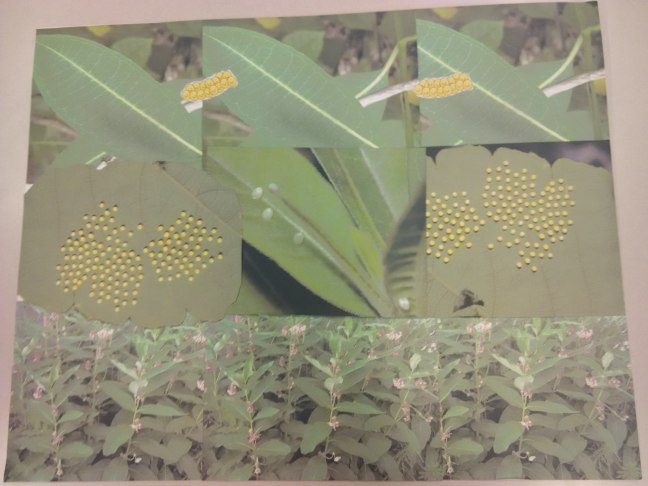
We created a game board with images of real and fake butterfly eggs. We asked our participants to sweep away all predators, like spiders, praying mantis, and lizards, that might eat the eggs. Paper cut-out predators were glued on tongue depressors and manipulated by the researchers.
This test not only taught the children about a butterfly’s predators but also provided us insights to the children’s preferences, like real images of the predators to the cartoon versions. We also learned that the children liked the element of surprise and speed to keep them engaged.

Prototype Experience 2 – A Butterfly Lifecycle
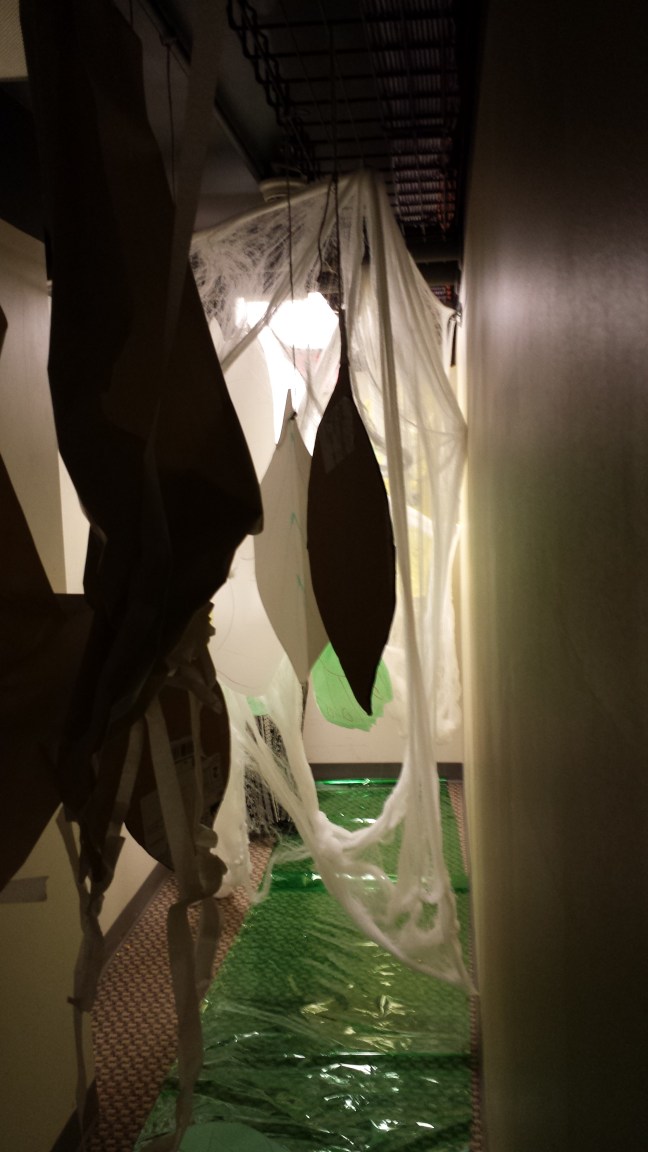
In order to create empathy for the butterfly, we created a scenario in which users experience the butterfly’s life cycle. Nature sounds and subdued lighting set the mood for participants, who would find themselves in an oversized egg created out of contact paper. They could feel the stickiness of the sides and had to break the masking tape barrier in order to get out.
Once out, the caterpillar participant steps onto oversized leaves to represent their journey before the pupa stage. The cocoon was created with synthetic webbing, mylar, and cellophane. We wanted the participant to feel cramped and have to struggle in order to get out. participants expressed a feeling of liberation upon exiting and seeing the opened butterfly wings.
Critical Design – A Pollinating Experience
Our critical design changed the direction of our museum experience. Initially, we had envisioned capturing images of digital butterflies that could be collected and shared. With the decline of butterfly populations and the concerns about global warming, we felt the need to give humans a butterfly’s view of its habitat.
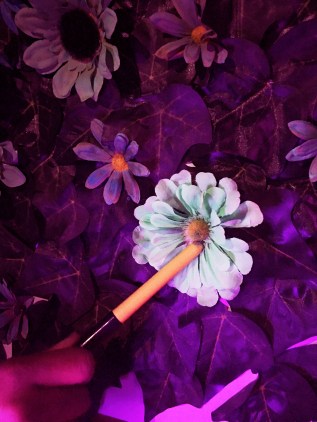
We used black light to simulate and neon paint to simulate a butterfly’s vision. Each participant would carry a pollen collector. Like a butterfly tongue, the tip would be placed in the center of the flower to collect pollen. The yellow pollen collector represents pollen not infected by herbicides, pesticides, and insecticides. The blue pollen collector represents poisoned pollen.

 Wellumania Designs